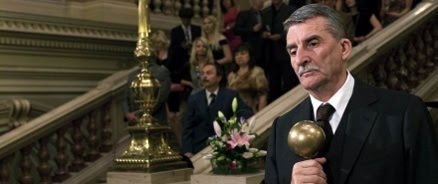
Tuesday, August 24, 2010

That was the MIFF that was

And not before time.

Here's an A-Z account of films seen that screened at the 2010 MIFF, with a few words on anything I didn't find time or energy to write about nearer the day, and even fewer words about anything that I did, accompanied by a link to the corresponding previous writings, whether written whilst having A Little Lie Down, or for a festival report published in Senses of Cinema.

The following includes next to no words on films to have already received a general release, or which are very, very soon to. I'll endeavour to catch up on the likes of The Special Relationship, Splice, Four Lions, Boy and The Killer Inside Me in a separate future post.

Adrift

A lovely, languorous look at the lives of a few current day, existentially angsty Hanoi dwellers.

There's a little more on Adrift within my report for Senses of Cinema on the 2010 Fribourg International Film Festival.

Air Doll

Air Doll
Setting the action in a tumbledown Tokyo far removed from the neon-drenched playground for drug addled young émigrés depicted in Enter the Void (about which, finally, more below), Hirokazu Koreeda casts a little magic realist spell upon a sex doll and brings it to life (as embodied by Korean actress Bae Doona), all awhile enshrouding proceedings in a haze of melancholia.

While Air Doll's mood is all very minor key, and its ending is horrific, the film it most reminds me of is Edgar Wright and friends' wonderful, ultimately upbeat rom-zom-com Shaun of the Dead. The premise of both films seems much the same: in an everyday megalopolis, everybody around you could overnight turn into killer zombies/animate sex dolls, and you'd be none the wiser.

(Speaking of Edgar Wright, I haven't yet seen Scott Pilgrim vs. the World, which, on MIFF's final day, went toe-to-toe in its single screening with the only screening of Apichatpong Weerasethakul's Uncle Boonmee Who Can Recall His Past Lives, an auteur stand-off which went unanticipated by the ultimately very annoying MIFF trailer, which, in correspondence with this year's festival's slogan “It's a Matter of Taste”, bellowed forth all sorts of inane, inexplicably American accent-inflected dialectical oppositions pitting auteur against auteur, beginning with “Apatow vs. Kubrick” (neither of whom, as with many of the names that followed, were represented at the festival anyway).

Clearly, come the festival's final day, the only contest between filmmakers being contemplated in any way by MIFF audiences was Wright vs. Apichatpong, i.e., whether to close their MIFF with the certainty of easy good times promised by Wright's Scott Pilgrim (due for a wide release within a week anyway) or with the sole Melbourne screening of this year's Palme D'Or winner, made by the man who made the unforgettable Tropical Malady (and who also had a directorial hand in the enjoyably forgettable, camp as all get-out The Adventures of Iron Pussy – true!)

For me, it would have been a no-brainer, had I not a non-MIFF commitment that day to spare me such an easy decision anyway. The upshot of which, notwithstanding that I've still seen neither: Apatow vs. Kubrick? Well that's just silly. But Apichatpong vs. Wright? Apichatpong, surely!)

Animation Shorts 1

Fatigue robbed me of most of this session. Were that I could remember, in particular, more than just the initial five of The Lost Thing's 15 minutes (d. Andrew Ruhemann & Shaun Tan). Why couldn't MIFF have more than just the one screening of its animation packages? The animations – and the animators – deserve better.

I can though remember Sarah Wickens' clever What Light (Through Yonder Window Breaks) clearly enough to mention it here and applaud its comedic, ontological play with light, zipping about an enclosed room full of everyday stuff to metaphorically and literally bounce off of.

Animation Shorts 2

Oh dear. Fatigue robbed me of some of this session, too. I was at least with it enough to appreciate how much the one film I was really looking forward to within this package, the Quays' Maska, went down like a lead balloon with the rest of the crowd. Its finish was greeted with no small amount of ironic cheering from a likely Tropfest-sensibilitied audience.

Perhaps that's fair enough; Maska probably would have been better packaged with the experimental shorts (much as, I'm sure, Guy Maddin's Night Mayor should have been too, rather than with the documentary shorts, which I missed, dagnabbit). On which note, the experimental shorts were sadly given equally short shrift within the program as the animations; there was in fact but one, solitary, far-from-prime-time screening at MIFF for each of Animation Shorts packages 1 and 2; “Doco Shorts” (perish the thought that we might not colloquialise the term “documentary” lest it sound, what, unsexy?), and “Experimental Shorts”.

But back quickly to the animations, and it's hats off to Tom Judd for Bruce, wherein an action hero is created out of pixels and meat, semi-Splice style, and made to perform in a real world 1980s platform game environment until coming to a comically pathetic end, and to Beomsik Shimbe Shim's bizarre and disturbing The Wonder Hospital, which might give pause to anybody out there considering putting themselves through any sort of irreversible procedure in the name of beauty. Kudos also to Emma Lazenby for Mother of Many, a lovely tribute to the undercelebrated art of midwifery.

Around a Small Mountain

Positively pithy by Jacques Rivette's standards, I can't say Around a Small Mountain did a tremendous amount for me; it seemed altogether too self-consciously minor.

I fancy that some folks out there are so besotted with Rivette that they'll declare this rather throwaway work, set around an ill-attended circus and starring a maudlin Jane Birkin and a quixotic Sergio Castellitto, a “minor masterpiece”. They can keep the noun; I'll retain only the adjective.

Bibliothèque Pascal

Bibliothèque PascalNotwithstanding a jarringly homophobic narrative development early on, this was one of this year's most exciting offerings. Take Suzy Bannion out of Suspiria and let her loose in the "porn torture"-riddled ramblings of a most unreliable narrator and you've got Bibliothèque Pascal.

A little more on Bibliothèque Pascal.

Black Bus

A documentary offering scary insights into applications of the male-chauvinistic doctrines of latter-day, post-‘modesty revolution’ Haredi Judaism. Not as enraging as it ought to have been, but it's interesting to note that the state of Israel is perfectly capable of persecuting its own every bit as much as its enemies.

There's quite a bit more on Black Bus at ArtsHub.

Border

MIFF's “Wild Things” section offered up both Border and Bresson's Au hasard Balthazar; therein lies the making for a wonderful Kuleshovian farmland double-bill. Considerably further removed from the norms of classicist narrative than Balthazar, the dialogue-free Border is a triumph of sound design in painting an audiovisual picture of hardscrabble lives eked out along the the Armenian-Azerbaijani border.

There's a little more on Border within my report for Senses of Cinema on the 2010 Fribourg International Film Festival.

Caterpillar

A determinedly unrelenting, harrowing and unapologetically unsubtle indictment of WWII-era Japanese nationalism from Kôji Wakamatsu, one of the most prolific and renowned directors of pinku eiga in that disreputable, but increasingly re-examined, genre's heyday.

A “war hero” and rapist returns home to his village, reduced to nowt but a mute, burnt head, a torso and an aggressive sexual appetite, which his wife, dutifully battling her own repulsion, tends to. Occasionally she parades him about the village, dressed in all his military finery, bedecked in medals. He eventually meets an appropriately ironic end.

Nobody, having been spared nothing, has enjoyed themselves in the meantime.

Certified Copy

Was Abbas Kiarostami's first film made outside of Iran more parts Luis Buñuel than Richard Linklater? I think so...

Quite a bit more on Certified Copy.

Enter the Void

If ever I find myself at a party with Gaspar Noé, I'll be sure to keep him away from the punch.

Enter the Void

His latest feature is sure one nasty, overlong, out-of-body bad trip that won't be namechecked in any Tokyo tourism brochures any time soon. Its lead, Oscar (Nathaniel Brown), a drug-peddling Canadian émigré, spends most of the film newly dead, a state we join him in experiencing, in accordance with theories exposited earlier in the film by Alex (Cyril Roy), one of Oscar's friends. Alex would have us believe that the experience of dying, as per The Tibetan Book of the Dead, has parallels in taking DMT, which Oscar is taking as he hits the town with Alex at the film's outset...

Enter the Void's first hour alone is troubling enough. Oscar clearly has the hots for his sister Linda (Paz de la Huerta), who, on getting reacquainted with his brother on arriving in neon-soaked Tokyo, becomes a stripper at a club run by a Japanese heavy. (Oscar meanwhile has been getting it on with a friend's mother. Ah – were it only Oscar and Lucinda! For added yuks.) Oscar and Linda, as we are none-too-subtly reminded once or twice, were orphaned through a horrific road accident not so very long ago... hence their (ahem) closeness.

Both are already leading a bottom-dwelling, downward-spiralling life in Tokyo ahead of Oscar's shooting death in a toilet cubicle.

Afterwards...

Well, the film's latter hour-and-a-half is, shall we say, rather laboured.... Navel gazing is taken to a whole new metaphoric extreme!

Time and again the camera skims across Tokyo rooftop after rooftop before entering some space or another where Oscar's nearest and dearest contend with the aftermath of his death. Each time the camera finally settles upon an enclosed space peopled by Oscar's folk tearing themselves and one another apart, the camera gyres wildly about that space, as if a hot air balloon barely tethered in swirling high winds; that space will eventually fish-eye in on itself and the camera will finally zoom down and out the other end through yet another umbilical rabbit hole in pursuit of variations upon the same...

That rabbit hole might be anything from a common kitchen sink plughole (in which respect Enter the Void superficially follows a time-honoured cinematic tradition) to a tray bearing a newly aborted foetus...

Interspersed amongst all of this are flashbacks through Oscar's life, leading to the moment of Oscar's very (re)birth, just ahead of which we aren't spared what is perhaps the cinema's most extraordinary cumshot (it's 'shot' vaginally, from within).

And that's about as much as I want to say about Enter the Void (other than also to mention that it has the most gobsmacking opening credits sequence you've ever seen) until I can see it again and check that I read it right. I have my doubts about certain elements... but that was probably just the drugs, right kids?

Film Socialisme

Never again, Jean-Luc, never again...

A little more on Film Socialisme.

Honey

Exemplary piece of so-called “slow cinema”. Must this term necessarily assume a pejorative dimension? Which filmmaker will yet reclaim this still newly coined term as a badge of honour and put to rest its bandying about as a damnation?

A little more on Honey.

I Killed My Mother

Ugly, ugly, ugly film by a precocious young man who knows how to exact strong performances from a cast (himself, as this film's lead, definitely included) but who seems clueless when it comes to lighting and composition. Nothing which can't be remedied.

A little more on I Killed My Mother.

I Love You Phillip Morris

I Love You Phillip Morris

Nothing less than a revelation. Roadshow, get with the program and RELEASE THIS FILM!

A little more on I Love You Phillip Morris.

In the Attic, or Who Has a Birthday Today?

My disappointment when I saw this last year was probably less based on the film's own merits than on my own expectations, likely unfairly high. That this was made by Jiří Barta, of Krysař (The Pied Piper of Hamelin) fame, had me expecting less a Czech stop-motion Toy Story, with a target demographic to match, than something of the power and virtuosity of The Pied Piper. I now really wish I'd seen it again, especially as I'm trying to improve my command of the Czech language.

There's a little more on In the Attic, or Who Has a Birthday Today? within my report for Senses of Cinema on the 2009 AniFest: International Festival of Animated Films.

Kawasaki's Rose

A fine new Czech film not a million miles thematically removed from The Lives of Others, but with all of its action taking place in the current day. When is a dissident not a dissident? I dare say this film resonates uneasily with any number of folks back in its home country.

A little more on Kawasaki's Rose.

Lebanon

I really didn't much care for Das Tank, accolades or no accolades. Nice sound design, but.

A little more on Lebanon.

Lemmy

Inept projection couldn't ruin this great fun, albeit overlong, tribute to one of rock 'n' roll's most indestructible, talismanic figures, Motorhead's Ian “Lemmy” Kilmister.

A little more on Lemmy.

Lola

Or “Monsoon Manila”. Or perhaps “Grandma vs. Grandma”. Certainly a highly immersive, neo-realist experience. Gets right in the wet, sticky thick of things, as two old ladies do their utmost to battle the elements and their lot in life in attaining moneys enough to do the right things by their sons, one of whom is now dead after an encounter with the other. Not half as grim as it sounds.

There's a little more on Lola within my report for Senses of Cinema on the 2010 Fribourg International Film Festival.

Mammuth

I don't know if it was just fatigue, but I slept through too much of Mammuth to be confident enough to say much of anything about it. This is probably a shame, as I loved directors Gustave de Kervern and Benoît Delépine's previous film, Louise-Michel.

Matinee

A little regrettably, this enjoyable collision of William Castle-inspired schlockmongering and the Cuban Missile Crisis was my only dalliance with the Joe Dante retrospective at MIFF. I wish I'd felt I had the strength to sign up for Dante's four-and-a-half-hour long The Movie Orgy; it sounds like it was a lot of fun, along the lines of “That's Exploitation!”, an extraordinary compilation of trailers New Zealand outré film impresario Ant Timpson prepared for the 3rd MUFF, back in the golden days of my involvement with said festival.

A little more on Matinee.

Osadné

A lovely, very droll documentary about a very small Slovakian village getting ever smaller and its attempts to stem that tide, ideally with the construction of a “chapel of grief”.

A little more on Osadné.

Rubber

A highly enjoyable film of great originality, great silliness and, ultimately, a great body count, courtesy of an irascible, jilted, psychokinetic killer tyre. Also notable for taking the film-within-a-film narrative device to new levels of absurdity.

A little more on Rubber.

Sex & Drugs & Rock & Roll

Sex & Drugs & Rock & Roll

Director Mat Whitecross is a very energetic fellow; track suit panted, he presided over a Q&A in Abu Dhabi last November after a screening of his and frequent collaborator Michael Winterbottom's The Shock Doctrine, a recent screen elaboration upon Naomi Klein's disaster capitalism opus of the same name.

Whitecross could barely stand still for a moment on that occasion as he rattled off quick-fire responses to a very inquisitive crowd. And it's that same sort of manic energy which he brings to the hyperactive opening of his Ian Dury biopic, Sex & Drugs & Rock & Roll, for better, and for worse.

It begins with a mad great flurry of rapidly edited images and vignettes, mixing animation with live-action, archival material with live rock 'n' roll and no small amount of fourth wall breaching, with Andy Serkis' Dury addressing a crowd within a theatre in a fashion not unlike Bronson in Nicolas Winding Refn's film of the same name, if he'd instead been positioned in London's Hackney Empire where Madness performed for Julien Temple (and Luke Cresswell)'s The Liberty of Norton Folgate.

In fact, I'd say Whitecross is heavily indebted to Temple and to the multi-media mosaic approach he adopted in his brilliant corrective to his own Great Rock 'n' Roll Swindle of 1980, 2000's The Filth and the Fury. An approach brought rather more successfully to bear in Temple's documentaries than in this biopic, especially within Sex & Drugs' opening half hour, when it tramples all over any hope for the film to get into a rhythm. It does settle down and come good after that though, and lets us get to know the principal characters rather better.

Admirably, this sure ain't no hagiography. Sex & Drugs makes Dury out to be something of a bastard when at his worst. More frustratingly, it's quite narrow in its focus, which is especially honed upon Dury's relationship with his son, Baxter (Bill Milner), and upon Dury's relationship with his own father before him (Ray Winstone). The film doesn't cover a great timespan, and doesn't offer all that much of an insight into the wider world of the times.

Performances, however, are absolutely superb: for those too young to recall the real Ian Dury, Andy Serkis simply will be their “Spasticus Autisticus”. And the music is fantastic, with The Blockheads providing the music for Serkis to sing over. If only “I Want To Be Straight” could have been included on the soundtrack and woven into the narrative.

Quibbles about a few shortcomings aside, it was a worthy and enjoyable Closing Night film, in a year in which far less flattering opinions were widely held of the film that opened proceedings.

Son of Babylon

Son of Babylon

One of the films of the festival, without a doubt. I've already said it often, but that won't stop me saying it again, for anybody who came in late: Son of Babylon plays not unlike a cross between John Hillcoat’s recent Cormac McCarthy adaptation, The Road, and something out of the Rossellini canon circa Germany Year Zero. With a dash of Turtles Can Fly thrown in for good measure.

It's a terrible shame that its screenings at MIFF went against its makers' wishes, as documented earlier in this blog. Oi vay.

A little more on Son of Babylon.
Some thoughts on “the Son of Babylon affair”.
And there's still more on Son of Babylon within my report for Senses of Cinema on the 2009 Middle East International Film Festival.

Survival of the Dead

Better than Diary of the Dead. But really: has the Dead series not already proven undead enough? I think it had its Day long ago.

A little more on Survival of the Dead.

Symbol

Symbol

This wonderful Japanese absurdist comedy is my my unheralded highlight of the festival.

A little more on Symbol.

Tehroun

A most unusual Iranian thriller which comes undone in its last act. Tehroun is likely the only film that will ever make me feel any sympathy whatsoever for the sort of man who would hire a baby for begging purposes.

There's a little more on Tehroun within my report for Senses of Cinema on the 2010 Fribourg International Film Festival.

Tetro

Had the last half-hour of Francis Ford Coppola's latest been as good as all that preceded it then this would have been a masterpiece. A massive improvement upon Youth Without Youth, mind you.

A little more on Tetro.

The Day Will Come

A histrionic, bourgeoisie-bashing German thriller that left me cold. Were that it had been made by Claude Chabrol!

A little more on The Day Will Come.

The Housemaid

I wish I'd seen Kim Ki-young's 1960 original, also screening at MIFF. I'm very glad though that I did at least see Im Sang-soo's 21st century re-imagining of it, which is a terrifically well-paced thriller, offering insights into the lives of South Korea's ultra-rich elite, and which ends... memorably.

A little more on The Housemaid.

The Illusionist

The Illusionist

A beautiful piece of work. May that more scripts by great auteurs, unproduced in their lifetimes, find their way into the hands of brilliant and sympathetic animator-directors.

A little more on The Illusionist.

The Juche Idea

A smartarsey, semi-mockumentary extrapolation upon the revolutionary film theories of Kim Jong Il. Some great found footage aside, The Juche Idea is just too darned smug for its own good.

A little more on The Juche Idea.

The Trotsky

Imagine the love child of Wes Anderson's Rushmore and Lindsay Anderson's If...., and you've got The Trotsky. Great fun.

A little more on The Trotsky.

To Die Like a Man

An underwhelming potboiler – especially given its praise on the festival circuit elsewhere – featuring a grand old clichéd coupling, an ageing drag queen and a junkie lover. There's been a little Catholicism and a little magic realist whimsy thrown into the mix, but To Die Like a Man still ain't no great shakes.

There's a little more on To Die Like a Man within my report for Senses of Cinema on the 2009 Mezipatra Queer Film Festival.

The Wedding Party

A very underwhelming Opening Night film. Rumour has it that it won't surface again for some time, not least before it's undergone some serious tweaking in the editing suite. I'd recommend, just for starters, getting rid of the reedy voiceover bookending the film in a wholly tacked-on-seeming fashion. The mostly peripheral character the voice belongs to seldom impresses as an observer of the wider goings-on within the film; having hers then serve as the voice of the whole film is a wholly wrongheaded manoeuvre.

A little more on The Wedding Party.

World on a Wire

World on a Wire

An extraordinarily prescient, made-for-TV production, anticipating the narrative and metaphysical concerns – if not the fashions nor the pacing – of The Matrix and Inception, by 26 and 37 years respectively. It's all the more extraordinary to consider that it's an adaptation of a novel, Simulacron-3, by Daniel F. Galouye, another nine years older still (and which is apparently also the inspiration for the 1999 film The Thirteenth Floor (d. Josef Rusnak), which I haven't seen).

Nearing 30 years after his death, will this be the last great Fassbinder rediscovery? I have my doubts...

Tuesday, August 17, 2010

Of voids and plenty

Hi all.

I had hoped to return to this blog rather sooner, particularly to sign off on MIFF for this year and move on, which I just cannot do without committing to pixels some thoughts on Enter the Void.

Unfortunately, all my best laid plans went to hell in a handbasket last Friday night when, extremely sadly, my beloved little cat, Pushpaw, named most appropriately after one of Frank's mercurial familiars in Jim Woodring's brilliant Frank comics, entered the void herself courtesy of a passing motorist, rendering my Thornbury far less Sunny than ever it's been before.

Pushpaw

So you'll excuse me if I hold off a little longer from summing up the 59th MIFF and posting about Gaspar Noé's epic, psychedelic ode to death.

For now instead, here's an updated pocket account of Melbourne's overwhelming imminent film festivalling future. Unbelievably, there are (at least) as many as seven film festivals on in Melbourne over the coming month, many with degrees of overlap with one another, all vying for our attention atop all that's otherwise screening in wide, limited or one-off release at one of our vast, sprawling city's umpteen temples to the seventh art. Anyone missing binging on film post-MIFF certainly needn't miss it for long.

To wit:

The AICE Israeli Film Festival runs Aug 17 (tonight!) - Aug 22.

The Indonesian Film Festival runs Aug 20-26.

L.A. Zombie
The Melbourne Underground Film Festival runs Aug 20-28. (With a bonus 'civil disobedience' screening of Bruce LaBruce's banned L.A. Zombie slated to occur on the 29th. Venue TBA.)

The Other Film Festival – new cinema by, with and about people with a disability – runs Aug 25-29. It'll include a World Premiere demonstration of the Eyeborg camera in operation!

The Russian Resurrection Film Festival runs Aug 25 - Sep 5.

Reel Anime runs Sep 2-15.

The Message Sticks Indigenous Film Festival runs Sep 4-7.

And, as if that wasn't enough...

The Melbourne Cinémathèque resumes its Wednesdaily screenings tomorrow with a four week long season entitled "Dark Star: Alain Delon". I'll be there tomorrow for sure to catch Delon at his peak in René Clément's Plein Soleil (1960) and Jacques Deray's La Piscine (1969).

And anyone really suffering MIFF withdrawals can catch any number of MIFF titles now entering release, per an earlier post of mine. The last two weeks alone have already seen the release of The Special Relationship, The Clinic, The Ghost Writer, Peepli [Live], Scott Pilgrim vs. the World and Splice; come this Thursday, Four Lions and Matching Jack will go wild as well.

The week following it'll be the turn of The Killer Inside Me and Taika Waititi's wonderful Boy.

3RRR Radiothon 2010

I'll be sure to speak about some of all of this when I'm on SmartArts from 11am this Thursday. Yes, that's half-an-hour earlier than usual, the better to help Richard Watts expound the innumerable virtues of subscribing to 3RRR during its annual Radiothon, the better in turn to keep my and his likes on the air for another year!

And now: a moment's churlishness

While there's so fucking much on in Melbourne at the moment – and let us not forget the imminence of the Melbourne Writers Festival as well – here're a few other things I'm aware of going on in the wider world which I'd dearly love to attend and so wish were on in Melbourne instead:

1. Cinema as Poetry: František Vláčil
running Sep 1-30 at London's BFI Southbank (and elsewhere in the UK too).

A comprehensive season of films from one of the Czechoslovak New Wave's leading lights, even if he's not a household name on the order of Miloš Forman, Jiří Menzel, Věra Chytilová, Jan Němec, Ivan Passer, Juraj Jakubisko and friends.

Marketa Lazarová

Still, at least more and more of this Czech filmmaker's oeuvre is becoming available on DVD courtesy of the untiring championing of the fantastic British label, Second Run. (What do you mean you haven't seen his mediaeval masterpiece, Marketa Lazarová (1967) yet? Fix it!)

2. William Lustig Presents
on now until Aug 20 at Anthology Film Archives in NYC.

In which the founder of Blue Underground, American distributor of finest, most disreputable, restored cult classic DVDs (a number of which are evidently turning up here licensed by Umbrella Entertainment), presents a fantastic selection of undercelebrated late '60s and '70s crime films, including a couple of the sorts of non-canonical post-nouvelle vague Jean-Paul Belmondo action flicks that never get screened or distributed 'round these parts.

Fear Over the City

Who wouldn't want to see Belmondo “leaping across rooftops, crashing through windows, and hurtling through subway tunnels atop [a] train, all accompanied by another classic Morricone score!” (From notes accompanying the screening of Fear Over the City (Henri Verneuil, 1975)).

It's for genre films like that, more than for his cinéphile-fodder collaborations with Godard et al, that Belmondo's (now craggy, George Hamilton-esquely tanned) face is still ubiquitous around Europe, wherever tobacco, newspapers and cheap DVDs are sold.

3. Australia’s Silent Film Festival
running Sep 11-25 in Sydney.

Ah hell, maybe I can get to some of this yet... Looks a great program. Why isn't this on in Melbourne? There's always room for one more!

And lastly

It would be dreadfully remiss of me not to post here a hearty CONGRATULATIONS! to Michelle Carey, my former Senses of Cinema colleague (she's still there; me: less so), on her appointment as Artistic Director of MIFF. My feeling is that she's been Melbourne film culture's Most Valuable Player for a few years now, and I really look forward to the new directions she'll take MIFF in, beginning with its 60th edition next year. It's fantastic news, methinks. Congratulations, Michelle!

Thursday, August 12, 2010

Of porridge for brains and a little more MIFF

My mind is porridge. Can I even still English? Will word brain once more shake hands with film brain and the former elicit from the overstimulated latter enough sense to successfully convey something here of my engagement with the arse end of the 59th MIFF?

The General

For me, an exhausted muddleheadedness is invariably symptomatic of my annual MIFF comedown, when I return to something akin to normal operating hours and functioning, characterised by rather less frenziedly haring about from cinema to cinema to festival club to cinema to Sunny Thornbury and back again for more the following day.

But, oh weary fellow traveller! With the ending of one Melbourne film festival (and how! - which is to say, I had myself quite the time at the Closing Night shindig), another several loom large on the near horizon. (For the particulars of just the soonest of which, see below.)

Truth be told, it's not just the more-than-a-fortnight long gross overindulgence in film that's slowed me right down, and resulted in no update to this blog in just on a week. There's also all that stuff that my likes must needs attend to in the course of returning to a few ordinary days in the life of...

In this instance, that 'stuff' includes, but is not limited to, bouts of gainful employment; the search for more – and more gainful – gainful employment; the joyous formal assumption of Godparenting duties, for want of a more secular term for the same; attending Czech evening classes; attending to my taxes; no small amount of animal wrangling, and a few all-too-little little lies down.

I've not 'arf had my work cut out for me lately.

But I no complain.

Gawd – I'm not quite ready yet to tackle all of what still remains to be accounted for of my MIFF. So we'll do this thing in instalments. And leave, I think, Enter the Void, till the very last. Till tomorrow, at the earliest.

I'm remembering, as I type this, my mortification when one Watts, Richard informed me I'd muddled my Buster Keaton masterpieces on air last week in challenging listeners to RRR's SmartArts to pick the scene where Buster breaks his neck in The General, screening at MIFF the day afterwards, with a new live score written, and to be performed by, The Blue Grassy Knoll, when it was in fact in Sherlock Jr. – one of my most beloved films of all time – that it occurred. Quelle horreur!

Oh, were that I had gotten along to The General this MIFF, and likewise, to the recently reformed Blue Grassy Knoll's presentation of Sherlock Jr. just a few weeks prior. I've seen them do Sherlock – and other Keaton greats – a few times before, but it never grows tired. It never will. A further shame that my memory had to blur these two films together just when I had a microphone in front of me! Just as it's been blurring all of my overtired recollections of my cinematic experiences from the tail end of this year's MIFF ever since, making for one great metafilmic, neuron-blocking mind-blancmange blobbing along every neural pathway in my brain and dulling anything it comes into contact with...

I'll try to uncloud it all a little, the better to give some sort of satisfactory account of films seen over my last few days at the 2010 MIFF.

We'll take it  one  film   at    a     time.

Symbol

Absolutely unique, a wonderful slice of absurdist nonsense which ultimately assumes cosmic – even Jodorowskyesque – proportions, and which could only have come from Japan.

Symbol

Director and comedian Hitoshi Matsumoto (already big in Japan!) places himself directly in front of the camera for 75% of the film, during which time he is mostly confined to the one room, featureless but for the gradual appearance of oodles of cherubim embedded into the walls, and for the objects that materialise in the room upon Matsumoto's initially tentative, and later, highly jaded, interaction with them. How ever will he escape from this room and its magnificently arbitrary torments?

The remaining quarter of the film chiefly concerns the travails of an unpromising Mexican wrestler, “Escargot Man”. It's with his story, almost played straight, that Symbol in fact begins, and we return to it at intervals throughout the film, until Matsumoto finally shows his hand and joins the film's two utterly disparate threads in the most extraordinary and hilarious fashion. There is not a person on the planet who will see coming one of the biggest laughs they will probably ever have.

Truly original, dumbfounding and very, very funny indeed, Symbol is my unheralded highlight of the festival.

Lebanon

Or Das Tank. Subtitle: The likely non-continuing adventures of four dumb guys in a tank. A tank, that is, rolling into the very beginning of the Israel-Lebanon war in 1982, and one its terrified crew can't escape from, but which other people seem to be able to enter and exit at will, sometimes even bringing company with them.

Lebanon

I know I shouldn't be cavalier or glib about films aiming to 'tell the truth' about very serious, unpleasant, recent and still raw historical matters, but I flatly didn't like Lebanon, no matter how autobiographical-cathartic it might be for director Samuel Maoz, whose wartime experiences it recounts. Never mind too that it's already been showered with accolades on the festival circuit.

Sure, I get it. Conscription is stupid. War is hell. I get it.

But Lebanon just bored me. Perhaps I'm all war filmed out. Or maybe the four dumb guys in the tank were just so unsympathetic that I just couldn't care less about their plight. I dunno.

Nice sound design, but.

Honey (d. Semih Kaplanoğlu)

A Turkish film exemplifying a certain mode of filmmaking, the merits of which have recently become the stuff of sniffy tiffs raging across the critosphere: so-called “Slow Cinema” (per Jonathan Romney in the February 2010 issue of Sight & Sound). Yes, very little happens in Honey, and it sure takes its sweet time proving that point, but, hey – why not just enjoy the ride? The scenery's very beautiful, after all.

Honey

The MIFF program tells me it's set in the Anatolian mountains. Let me tell you, they're very picturesque indeed (at least, in the right steady hands, as here). There's nowhere else that comes to mind where I'd rather a film, full of sleepy long takes, be set, in which a young boy struggles with a stutter, a father struggles to find enough wild honey to support his family and nine tenths of bugger all else happens.

Honey was lovely; I took my parents and my sister along to see it so they might all better understand this 'film festival thing' I'm so enamoured with, and they're all still speaking to me so I know I done good.

*

That'll do for now. More on MIFF is still to come.

Meanwhile, as mentioned above, here's an intimidating rundown of Melbourne's imminent film festivalling future:

The Indonesian Film Festival runs Aug 20-26.

The Melbourne Underground Film Festival runs Aug 20-28. (With a bonus 'civil disobedience' screening of Bruce LaBruce's banned L.A. Zombie slated to occur on the 29th. Venue TBA.)

The Other Film Festival runs Aug 25-29.

The Russian Resurrection Film Festival runs Aug 25 - Sep 5.

The Message Sticks Indigenous Film Festival runs Sep 4-7.

And, lest I forget, post-MIFF the Melbourne Cinémathèque resumes its Wednesdaily screenings next week. And how! With a four week long season entitled "Dark Star: Alain Delon". That's how.

We don't know how lucky we are.

Friday, August 6, 2010

Of voids, more and less: MIFF days 12 and 13

This blog just can't keep up with me...

Enter the Void

I'd love right now to write at length about that wag Gaspar Noé's newie, Enter the Void, which I emerged reborn from a screening of but half an hour ago.

But really what I, if not this blog, most need right now... is a little lie down.

Fortunately, here's A Little Lie Down I prepared, and had all but ready to go live, a little earlier today, before realising I needed urgently make yet another cutting-it-too-fine, mad dash from Sunny Thornbury into the CBD to get to a screening.

So: a highly potted, Enter the Void-free account of my last few days' MIFFing will have to suffice for this post.

*

First thing this morning I dropped by the Melbourne Art Fair at the Royal Exhibition Building to participate in a live 'outside broadcast' of 3RRR's “SmartArts”, whereupon I did my best to cram my thoughts on a week's MIFFing just past, and on the festival's last few days just ahead, into a pithy, fun-filled 15 minutes.

Yesterday was my most demanding day of the festival, taking in Chris Morris' hilarious, knockabout suicide bomber comedy Four Lions in the morning (outside of MIFF proper, at a media screening), followed by all three-and-a-half hours of R.W. Fassbinder's extraordinarily prescient, made-for-TV production World on a Wire, which anticipates the narrative and metaphysical concerns – if not the fashions nor the pacing – of The Matrix and Inception, by 26 and 37 years respectively!

A quick soup and some fine company – both highly necessary – helped revive me for Koji Wakamatsu's Caterpillar, a harrowing and unapologetically unsubtle indictment of WWII-era Japanese nationalism, ahead of a festival highlight, Abbas Kiarostami's Certified Copy, about which I'll immediately trouble to say a little more.

Kiarostami's first feature made outside of Iran has seen a lot of people looking to Richard Linklater as a first point of comparison, citing, in particular, Before Sunset, and Before Sunrise before that, as belonging to the same gen(r)ealogical tree. I will pay that, but that sure ain't the whole story.

Certified Copy concerns a French antique shop owner (a fabulously skittish Juliette Binoche), and an English writer (William Shimell – a cross between Dustin Hoffman and Shaun Micallef) whose recent opus is an investigation into 'originality' in art. These two embark together upon a locquacious but increasingly fractious rambling Tuscan adventure. (A superbly shot one, I might add.)

Certified Copy

For all the film's superficial Linklaterishness, I think the cinematic figure Certified Copy most harkens back to – and here we might like to indulge ourselves with believing a small cameo from Jean-Claude Carrière is a clue – is none other than that rascally old surrealist, Luis Buñuel. For Certified Copy features one extraordinarily adroit piece of narrative sleight-of-hand that comes to assume positively Buñuelian dimensions, especially per Buñuel's latter day masterpieces, often co-written with Carrière, with their penchant for surreally skewering the lives, loves and lusts of their bourgeois protagonists through the imposition of whimsical flights of metaphysical fancy, ever taking gleeful great liberties with the earthbound conventions of that tired old warhorse, classical narrative.

Which isn't to say that Certified Copy isn't still every bit a Kiarostami film. Never mind that it's set in a world far removed from Iran and features dialogue in English, French and Italian. Its dialectical play with notions of originality and duplication/replication, which doesn't so much just permeate the narrative as metaphysically warp it, marks it as every bit as philosophically inquisitive, reflexive and hence, Kiarostamian, a work as any of his previously celebrated features.

I've plain run out of time again, and haven't even made mention of Peepli [Live], a highly discomfiting satire about Indian farmers living well below the poverty line, for whom suicide emerges as a good career move, as the government will compensate a suicide's family for their loss! Nor have I got to Jacques Rivette's latest, Around a Small Mountain, in which, as is commonly observed of Rivette's work, the play's the thing. I like to think I'll find time yet to come back to both of these, and more seen at MIFF besides.

Dagnabbit, I gots to go. The animation packages from a few days ago will also have to wait for another day to be granted their column inches here.

But meanwhile – Melburnians, see you over the last few days 'round the traps at MIFF!

Tuesday, August 3, 2010

Of mothers and mants: some of MIFF days 9 and 10

I Killed My Mother

Director Xavier Dolan, recently turned but 21 years of age, is Hubert, the 16-year-old gay lead in this new comedy-of-sorts which begins looking for all the world as if it'll be utterly insufferable... but proves otherwise.

I Killed My Mother

Hubert, for the most part, cannot stand his mother (Anne Dorval). Hence we are subjected to recurring shouting matches and antagonistic games of silly buggers between the two of them, often held within the incredibly dingy house they both call home. At least, I think it's dingy. It's a little hard to tell, because you can barely ever make out any of it. It's always extremely poorly lit, and I found it impossible to tell whether it's meant to be, i.e., whether it's a deliberate aesthetic strategy on Dolan & co.'s part, perhaps the better to plunge us impressionistically into the ever strained atmosphere of the household. Or, likelier, it's simply just very amateurishly lit, and a match then for the often very awkward compositions that plague the entire film.

Nevertheless, I somehow found myself interested in whether Hubert and his long-suffering mother mightn't be able to reconcile matters. Seems no amount of ostensible technical incompetence can rob a film of its heart, and I Killed My Mother, which gives every impression of coming from a very real place, has plenty of it. And there are some real laughs to be had, in close to equal weighting with the film's more histrionic elements.

In summary, then: a rather flawed film, but one which still has some appeal.

Matinee

#1 festival guest Joe Dante gave a wonderful introduction to the underattended screening of this little known 1993 gem; I dare say he'd have given just as good at the Q&A afterwards as well, but, alas, I had to skedaddle to be sure to catch Hirokazu Koreeda's Air Doll (more on which, soon!)

Matinee

In the meantime, I thoroughly enjoyed this nostalgic trip back to a more innocent time, when the Cuban Missile Crisis was newly scaring the bejeesus out of Americans and, more importantly, multiplexes hadn't been invented yet!

Set in Key West, Florida, Matinee concerns itself with the intersection of the real world backyard scares of the missile crisis and the rather safer big screen ones of Lawrence Woolsey (John Goodman), an Alfred Hitchcock by-way-of William Castle-esque figure rolling into town to drum up business for his new gimmick-laden feature film, Mant!.

Mant!, viewed in snatches during the latter half of the film, is itself a rather wonderful creation, and one which would have done Roger Corman proud. It concerns a rogue man-cum-giant-ant, and brought home to me the fact that the happy hucksterish likes of William Castle long could have laid claims to have pioneered 'expanded cinema', and that it really oughtn't be considered the exclusive domain of the cinematic avant-garde, as some histories would have it...

Mant!

While the missile crisis is an important, well integrated backdrop to the film's narrative, and the sense of time and place are well established accordingly, there's no losing sight of what Matinee is chiefly about: the joy of going to the pictures in a bygone era when the cinema was king and there was no better, more fun place to go of an afternoon or an evening.

Oh! – and rhymingly happily with the gloriously daft Rubber, seen earlier at MIFF, a young Naomi Watts appears in a sequence parodying the anodyne Disney movies of the time, a sequence in which her character and her dapper but ineffectual boyfriend need not fear baddies, because her Uncle is a heroic, no-nonsense shopping trolley...

AND …


COMING SOON …


IN A SHORT ENGAGEMENT EXCLUSIVE TO THIS BLOG!

My thoughts on Air Doll, Peepli [Live], MIFF's animation packages, and more...

Sunday, August 1, 2010

MIFF days 7 and 8

I Love You Phillip MorrisTime's against me, so I'd best make rather brief my account of a few films seen over two of the last three days at MIFF, though I might come back in a day or two to write a little more expansively on one or two of them, those as which most deserve it, none more so than would the first cab off the rank.

I Love You Phillip Morris (d. Glenn Ficarra & John Requa, writers of Bad Santa)

The highlight of the festival for me so far, an absolute revelation! I'd heard from abroad it was good; it's been in circulation, of a sort, for quite a while already. Locally, Roadshow has been sitting on it for months, apparently clueless as how on Earth to pitch to the mainstream so extremely black and unflinching a comedy, based upon extraordinary true recent events, as this, in which Jim Carrey and Ewan McGregor play lovers...

Carrey has never been better than as conman and escape artist nonpareil Steven Russell. McGregor, as Phillip Morris – the film has nothing to do with the tobacco industry – is greatly affecting as the object of Russell's madly, hilariously criminally expressed affections.

No film has pulled the rug out from under me so brilliantly – or with anything like close to as much chutzpah – as this in a long time. I'll be appalled if Roadshow release this straight to DVD; I Love You Phillip Morris is simply brilliant.

Tetro

I thought Francis Ford Coppola's previous film, 2007's Youth Without Youth, was a dreadful load of old tosh. With Tetro as further evidence, I'm coming to think that Coppola may be going just a little bit mad, but I do have to concede that, barring Tetro's last half hour, when the wheels really come off, Coppola can still turn it on. For this rather strange tale set principally in Buenos Aires, of filial failings and inverted Oedipalism, is strikingly beautiful to behold, presented, flashbacks aside, in gorgeously crisp black-and-white 'Scope. And there really is no telling how the narrative, principally concerning a strained reunion between long estranged brothers (Vincent Gallo as Tetro, a mercurial failed writer, and Leonardo Di Caprio lookalike Alden Ehrenreich as virginal little brother Bennie), will pan out. While this is for the better for its very intriguing first hour-and-a-half, it's for far the worse in its utterly daft last half hour. Still, I'm very glad I rose above my doubts and bothered to see it. (And you can never include too much of Powell and Pressburger's The Tales of Hoffmann in a film.)

Kawasaki's Rose

Kawasaki's Rose

Although a Czechophile, I am far more conversant with films from the dizzy heyday of the Czechoslovak New Wave than I am with those of one of the Czech Republic's most celebrated latter day directors, Jan Hřebejk. I'll be concertedly looking deeper into his earlier work shortly, most impressed as I, and a few fellow Czechophiles, were with this multi-stranded, cleverly flashback-free, Lives of Others-inspired current day look back into pre-Velvet Revolution Czechoslovakia.

Its title refers to a complex origami creation, which, while having some direct narrative significance within the film, is more meant as a metaphor for the many layers underlying the reality of life for those now thriving in a post-communist state but whose earlier lives may have been marked with fateful compromises and Faustian pacts.

Atop its many other merits, it's a terrific film for a learner of Czech, with a wonderful final sequence marked by a thesauran explosion of insults that one character had long wanted, with good reason, to hurl at another. I'll be looking to grab this one on DVD when Madman get around to releasing it locally, the better to learn the Czech for “fuckwit” and “rotten cunt”, without which my life, and in particular, my Czech vocabulary, is sadly incomplete.

The Juche Idea (d. Jim Finn)

I didn't much care for this semi-mockumentary investigation into the little-travelled revolutionary film theories of North Korean despot Kim Jong Il, which accord with the “Juche” ideology first expounded by his equally lunatic father, Kim Il-sung. I found it messy, nowhere near as funny as it thought it was, and ultimately rather tiresome. Its best moments were when footage from North Korean films (and television?) was left to speak for itself, rather than when anti-capitalist mock-Kim-isms were given to a faux documentary subject – a woman purporting to be on a Juche arts residency in North Korea (as if!) – to blither to the camera.

In its favour, it did feature fabulous footage, all too briefly, of a woman juggling three live doves, one of the strongest and strangest images of this year's MIFF.

The Son of Babylon affair and other controversies for MIFF in 2010

Son of Babylon
Well, no amount of cheerleading here or elsewhere is likely to have any impact whatsoever now on the chances of Son of Babylon receiving an encore screening at MIFF; it transpires that its two previous screenings both flew in the face of its producers' and director's wishes, something which came to light only on Friday just past, not that you'd know about it through either MIFF or through the mainstream media.

I feel very sad – and rather conflicted – about this. I would have it that as many people, spread as far and wide across the globe as possible, could see this superb, harrowing film, which, a la Bahman Ghobadi's extraordinary Turtles Can Fly, is hard to credit was even made, let alone made so well and to such powerful and profound an end result.

However, knowing that to screen it here – to have screened it here twice already – goes altogether against the wishes of its producers, in connection with their horror at belatedly discovering that MIFF is in a cultural partnership with the state of Israel, troubles me considerably.

My lived experience in the Middle East runs only as far as 10 days spent in Abu Dhabi just last year, for the most part cocooned in the incredible unreality that was to be a pampered guest of the impossibly deep-pocketed 3rd Middle East International Film Festival, covering this fledgling would-be A-list festival for Senses of Cinema. But while that meant I spent precious little time amongst the everyday folk of the UAE's capital – my experiences of downtown Abu Dhabi were limited to just a couple of desultory, slightly nervous ground level sojourns and no small amount of al fresco shisha smoking in the company of an American expatriate – there was nonetheless absolutely no misinterpreting the wider Arab world's feeling towards the conduct of the state of Israel, to the limited extent they ever even acknowledge it as a nation state at all. The depth of Arab ill-feeling towards Israel, with, of course, particular respect to its part in the inexorable Israel-Palestine conflict, is not something I would ever think to trifle with.

It saddens me that I no longer feel I can (futilely, anyway) champion an encore screening of this wonderful film at MIFF and will instead simply hope that one of Australia's many fine exhibitors/DVD distributors picks it up to give it a second life, and a far wider audience, around these parts.

L.A. Zombie
Anyone keen to read more about this rather messy second controversy to hit the 2010 MIFF (the first being, of course, the rather absurd business of the Australian Classification Board's eleventh hour refusal to allow MIFF to screen L.A. Zombie (almost agreeably absurd – a man named Donald McDonald bans a film made by a man named Bruce La Bruce – you just can't make this stuff up!)) ought to read “How the Melbourne Film Festival embraces apartheid Israel” on Sydney-based multihyphenate Antony Loewenstein's blog, which gives due consideration to a blow-by-blow account of a handful of oppositional leaked correspondences between the Son of Babylon production team and MIFF Director Richard Moore, correspondences reproduced verbatim elsewhere online.

I have to admit to considerable ambivalence about the online publication of these leaked emails, which is why I won't provide a link to them here. (If you really feel you must read them, you can be assured you'll have little trouble finding them.) Much of my ambivalence is in fact less concerned with the privacy issues surrounding putting into the public sphere a professional dialogue that was, of course, originally conducted privately, but rather with the unsanctioned exposure of the contact details of the parties concerned. That, for mine, is a bridge too far. I am in turn further troubled that my highlighting my concern with this instance of a world's worst practice might also only lead to a wider discovery of those very materials that I think oughtn't be exposed in the first place. Please, don't go there, girlfriends!

Anyway, moving on from the particularity of the Son of Babylon affair: Jacinda Woodhead's “Occupied with free speech” on the ABC's “The Drum Unleashed” makes for interesting further reading, in considering whether MIFF's recent receipt of Liberty Victoria's free speech award, the Voltaire award – about which there was some self-congratulatory chest-thumping during Richard Moore's Opening Night speech – isn't something of a travesty in light of the festival's acceptance of sponsorship from the state of Israel.

We live in interesting times...